
Alex T. Grigas

Protein Biophysics · Soft Matter · Computational Biology

Alex T. Grigas

About

I'm a computational biophysicist working at the intersection of protein physics, soft matter, and tissue mechanics. I received my Ph.D. in computational biology and bioinformatics from Yale University in 2024, advised by Corey O'Hern. My doctoral work was in equal parts protein structural informatics and soft matter physics. Since 2024, I have been a postdoctoral researcher in the Syracuse Physics Department, working with M. Lisa Manning. In collaboration with Alessandro Mongera, we have developed new discrete element models for dynamic and sparse tissues under tension. See below for highlights of my work and my CV.
Research

Protein jamming transition

Protein folding as a jamming transition

Protein Physics Jamming All-atom modeling

Protein cores all pack to the same density (φ ≈ 0.55), but there has been no physical explanation for why. We show this value marks the onset of a jamming transition: as hydrophobic interactions drive collapse, the core undergoes a floppy-to-rigid transition with the same power-law scaling hallmarks seen in jammed particulate systems. To demonstrate this, I built a new all-atom protein model from scratch — using only hard-core repulsion, bond geometry, and weak hydrophobic attraction — that achieves near-zero Ramachandran and side-chain dihedral outliers without explicit dihedral restraints, staying within ~1 Å RMSD of crystal structures at jamming onset and refolding from partially unfolded states. The model shows that the stereochemical constraints of real amino acids shift jamming onset from φ ≈ 0.63 (simple polymers) down to exactly the φ ≈ 0.55 observed in nature.

CIL-Crawling
CIL-Pulling

Sparse mesenchymal cell networks as a fluid under tension

Active Matter Tissue Mechanics Morphogenesis

Embryonic mesenchymal tissues are porous, under tension, and flow like a fluid — a combination that naively should be unstable. We developed a new particle-based interaction model with hysteretic sticking and stochastic bond kinetics to show that contact inhibition of locomotion (CIL) resolves this paradox, directing cell activity away from neighbors to prevent clustering. Mean-field continuum equations connect cell-scale parameters directly to emergent diffusivity, tension, and structural texture, collapsing simulation data across eight orders of magnitude and matching quantitative measurements in the avian presomitic mesoderm.

Repulsive compression
Attractive collapse

Connecting polymer collapse and the onset of jamming

Jamming Polymer collapse Core packing

Protein cores pack to the same density as jammed repulsive amino acids — but proteins collapse via attraction, not compression. Is the correspondence deep or coincidental? I developed simulations of attractive and repulsive bead-spring polymers and disconnected disks under open boundary conditions, including a novel radial compression protocol for generating jammed packings without periodic boundaries. Collapsed attractive polymers quenched below the glass transition reach the same interior packing fraction as jammed repulsive systems across all system sizes, damping rates, and initial conditions. By decomposing the dynamical matrix into stiffness and stress components, I showed that repulsive polymer packings are hypostatic but effectively isostatic when accounting for quartic modes, and that attractive packings are also effectively isostatic under a contact definition set by the change in interaction stiffness. All four systems — repulsive and attractive, connected and disconnected — share the same power-law scaling for the vibrational density of states and excess contact number, establishing a universal connection between polymer collapse and jamming.

CV

Download Full CV

Positions & Education

Postdoctoral Researcher — Syracuse University
Physics Dept. · Adviser: M. Lisa Manning
Ph.D. in Computational Biology & Bioinformatics — Yale University
With distinction · Integrated Graduate Program in Physical & Engineering Biology · Adviser: Corey S. O'Hern
B.S. Biochemistry & Molecular Biology / B.A. Philosophy — Penn State
Magna cum laude / Summa cum laude · Honors Thesis with Christine Keating

Publications

  1. J. A. Logan, J. Sumner, A. T. Grigas, M. D. Shattuck, and C. S. O'Hern, "The effect of stereochemical constraints on the structural properties of folded proteins," Phys. Rev. E 112 (2025)
  2. A. T. Grigas, Z. Liu, J. A. Logan, M. D. Shattuck, and C. S. O'Hern, "Protein folding as a jamming transition," PRX Life 3 (2025)
  3. S. Viswanath, D. Bhaskar, D. R. Johnson, J. F. Rocha, E. Castro, J. D. Grady, A. T. Grigas, M. A. Perlmutter, C. S. O'Hern, and S. Krishnaswamy, "ProtSCAPE: Mapping the landscape of protein conformations in molecular dynamics," Molecular Machine Learning Conf. (2024)
  4. A. T. Grigas, A. Fisher, M. D. Shattuck, and C. S. O'Hern, "Connecting polymer collapse and the onset of jamming," Phys. Rev. E 109 (2024)
  5. Z. Liu, A. T. Grigas, J. Sumner, E. Knab, C. M. Davis, and C. S. O'Hern, "Identifying the minimal set of distance restraints for FRET-assisted protein structural modeling," Protein Science 33 (2024)
  6. A. T. Grigas, Z. Liu, L. Regan, and C. S. O'Hern, "Core packing of well-defined x-ray and NMR structures is the same," Protein Science 31 (2022)
  7. A. T. Grigas, Z. Mei, J. D. Treado, Z. A. Levine, L. Regan, and C. S. O'Hern, "Using physical features of protein core packing to distinguish real proteins from decoys," Protein Science 29 (2020)
  8. Z. Mei, J. D. Treado, A. T. Grigas, Z. A. Levine, L. Regan, and C. S. O'Hern, "Analyses of protein cores reveal fundamental differences between solution and crystal structures," Proteins: Struct. Func. Bioinf. 88 (2020)
  9. F. P. Cakmak, A. T. Grigas, and C. D. Keating, "Lipid vesicle-coated complex coacervates," Langmuir 35 (2019)
  10. K. Reiss, U. N. Morzan, A. T. Grigas, and V. S. Batista, "Water network dynamics next to the oxygen-evolving complex of photosystem II," Inorganics 7 (2019)

Under Review & In Preparation

  1. A. T. Grigas, R. S. Negi, E. Maniou, G. L. Galea, A. Michaut, A. Mongera, and M. L. Manning, "Sparse mesenchymal cell networks as a fluid under tension" — Under review, Nature Physics (2025)
  2. J. Sumner, N. Brandt, G. Meng, A. T. Grigas, A. Cordoba, M. D. Shattuck, and C. S. O'Hern, "Assessment of scoring functions for computational models of protein-protein interfaces" — Under review, Phys. Rev. E (2025)
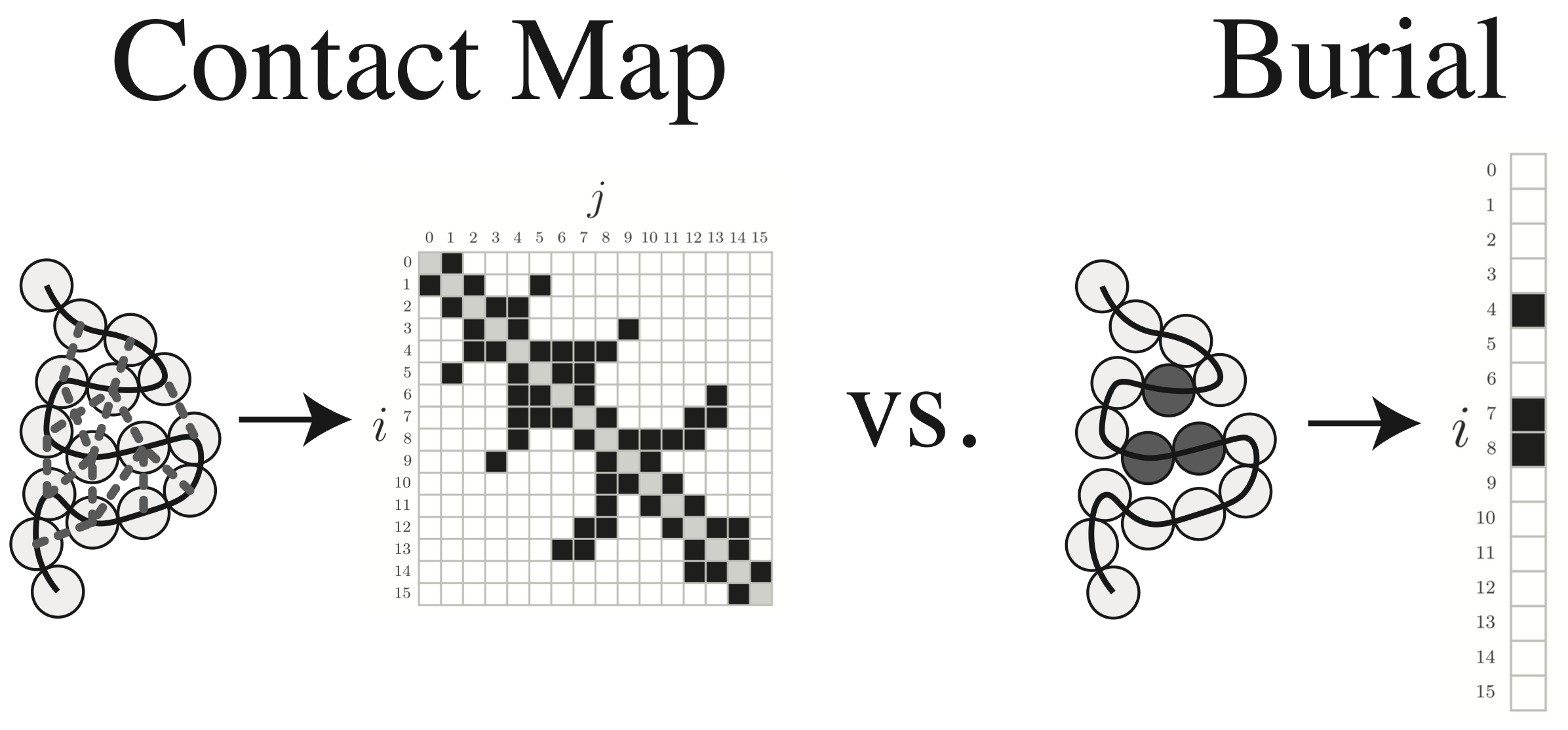
  3. A. T. Grigas, J. Sumner and C. S. O'Hern, "Residue burial encodes a protein's fold" — In preparation (2026)

Selected Talks

Contributed Talk — APS March Meeting
Invited Mini-Symposium Talk — Society for Mathematical Biology
Invited Talk — Computational Protein Design Network
Invited Talk — APS March Meeting

Teaching & Mentorship

Research Mentorship
19 mentees across O'Hern and Manning groups: graduate students, postbacs, undergraduates, and high school interns
Teaching Assistant — Yale University
Biological Physics, Integrated Workshop, Intro to Computing, Dynamics · Avg. 4.4/5 student evaluations

Technical Skills

Languages Python C/C++
Scientific Computing NumPy SciPy PyTorch Matplotlib
Structural Biology ESM2 AlphaFold RosettaFold GROMACS BioPython VMD
Infrastructure HPC SLURM HTCondor Docker Git

Awards

1st Place, 5-Minute Thesis — USNC/TAM
Finn Wold & Protein Science Young Investigator Travel Award
Protein Society Graduate Student Poster Award
Paul Axt Prize — Penn State Schreyer Honors College